Across Middle Tennessee, residential rodent activity rises dramatically during autumn temperature drops and wet spring shifts. Homes in historic neighborhoods like 12 South, Belmont-Hillsboro, and East Nashville often…
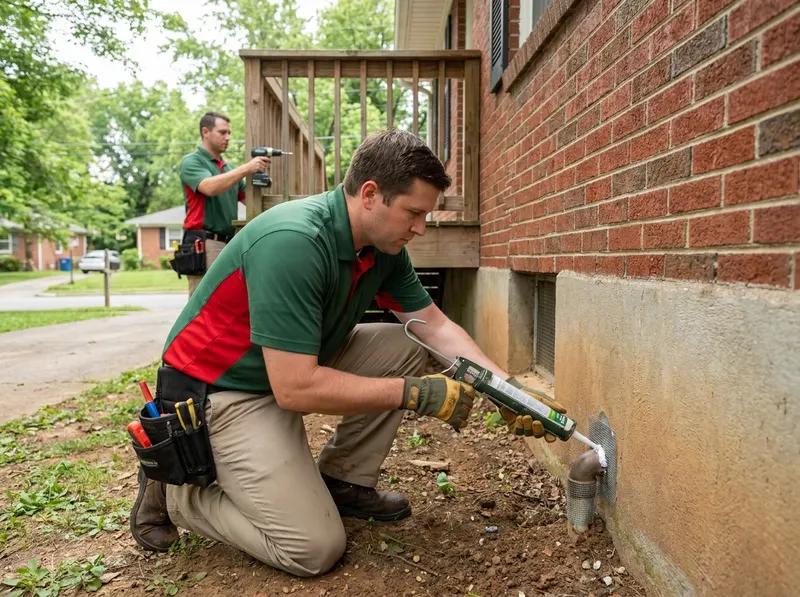
Across Middle Tennessee, residential rodent activity rises dramatically during autumn temperature drops and wet spring shifts. Homes in historic neighborhoods like 12 South, Belmont-Hillsboro, and East Nashville often rest on aged stone, brick, or mortar foundations that develop settle cracks larger than a quarter inch. Mice require an opening of just 0.25 inches to squeeze into living spaces, while mature Norway and roof rats penetrate gaps measuring 0.5 inches or wider. Standard broadcast rodenticides simply mask structural defects while introducing severe secondary poisoning hazards to household dogs, indoor cats, and native raptors. Residential rodent exclusion provides a non-toxic alternative by sealing structural architecture using durable, bite-proof materials specified by the Centers for Disease Control and Prevention, including 19-gauge galvanized wire hardware cloth, silicone-embedded copper mesh, and metal flashing.
In newer or renovated framing throughout The Nations, Germantown, and Sylvan Park, rodent intrusions frequently bypass the main living quarters and establish nesting runways directly inside floor joists, conditioned crawlspaces, and loose roof eaves. The trade-off between exterior exclusionary repair and ongoing chemical baiting comes down to structural integrity versus continuous intervention; setting poison bait stations outside requires recurring service visits, whereas exclusionary sealing directly addresses building envelope vulnerabilities. Structural work focuses heavily on exterior ground-level utility conduits where HVAC refrigerant lines, natural gas pipes, and electrical cables enter through brick weep holes or vinyl siding gaps. The Environmental Protection Agency identifies structural exclusion as the primary foundational tier of Integrated Pest Management, prioritizing physical barrier installation before any interior mechanical trapping is deployed.
Neighborhoods bordering thick woodlands and river drainages, including Green Hills, Inglewood, Donelson, and Antioch near J. Percy Priest Lake, face intense pressure from roof rats traveling along tree canopies onto gutters and fascia boards. Roofline sealing secures attic soffits, dormer returns, and ridge vents using materials aligned with InterNACHI crawlspace inspection standards. SilverFern Bug Services installs corrosion-resistant mesh across foundation crawlspace vents and seals subfloor pipe penetrations beneath kitchens and bathrooms. Every remediation follows structural fire-resistance protocols outlined by the National Fire Protection Association and International Code Council guidelines for residential ventilation maintenance. Rather than forcing homeowners into open-ended multi-year chemical contracts, technicians resolve the immediate scratching noises inside ceilings and attics through physical closure, followed by targeted, non-rodenticide mechanical removal.
Every job gets a firm, written price after a free on-site visit.
For standards, safe disposal, and service guidance on pest control services in Nashville, TN, useful references include U.S. EPA, ENERGY STAR, U.S. Dept. of Energy, Consumer.gov, U.S. Census Bureau, and Google Maps. General consumer and small-business resources are available from USA.gov, Better Business Bureau, FTC Consumer Advice, U.S. Small Business Administration, and Ready.gov.
Tell us about your residential rodent exclusion job in Nashville and we'll send a clear, written quote, usually the same day.
 SilverFern Bug Services